Article
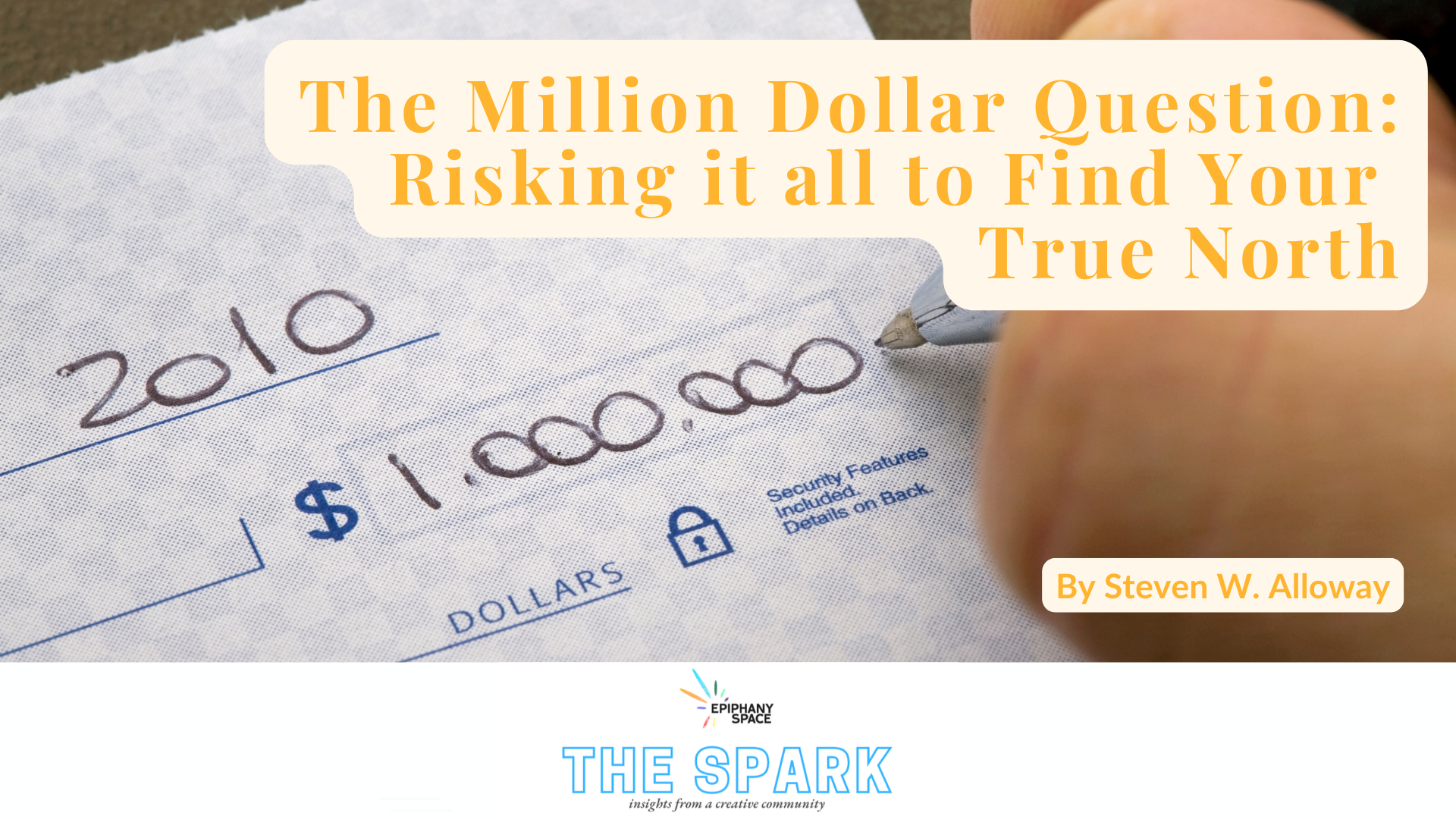
The Million Dollar Question: Risking It All to Find Your Creative True North | By Steven W. Alloway
The Million Dollar Question: Risking It All to Find Your True North
By Steven W. Alloway
In the movie Office Space, several characters are asked, “What would you do if you had a million dollars?” The purpose is to ascertain what they’re passionate about and thus what they should be doing with their lives. If you found yourself with enough money to meet all of your needs and cover all of your bills and expenses, so that you didn’t have to work for a living anymore… What would you do with your time? The example given in the film is, “If you say you’d want to fix up old cars, then you’re supposed to be a mechanic.”
Unfortunately, the characters keep misinterpreting the question, talking instead about how they would spend the money, rather than how they would spend their lives. Even the ones who do understand the point of the question don’t really have good answers for it, with the main character concluding that, if he no longer had to work, he would just do nothing.
It’s a flawed question for a number of reasons. In addition to the ambiguity, it’s also easy to get caught up in the semantics of it: Would a million dollars even be enough anymore, to live on in today’s economy? Would it be enough to take care, not just of you, but of the people you love? Not to mention the fact that, in the moment, those non-answer answers like “doing nothing” can sound like a pretty sweet deal.
So instead, I have a slightly different question. If you’re trying to find your creative True North, I think this could be a good way to help you determine what really matters to you.
The Million Dollar Question
Say you did get that million dollars. Or, in today’s economy, let’s make it $10 million. Enough that you and your family are taken care of. You can live a comfortable life, have whatever you want, and never have to work again.
What would you be willing to risk losing that money for? What cause, what project, what endeavor, would be worth giving up that comfortable life for and starting all over from scratch? What idea would you put the money into, even if there was no guaranteed return on your investment?
I’ve got a whole list, depending on how much of a windfall it is. A few hundred dollars? Rent a theater, mount a show. A few thousand? Same, but pay all the actors, crew, etc. A bit more? Buy a space, convert it into a theater, have a permanent stage to do whatever projects I (and my group, and my friends) want. A few million? Spend a couple of months in Ireland, shooting a television pilot. A few more million? Mount a show on Broadway, or the West End – maybe take it on tour.
Risk and Reward
Honestly, for me, I don’t think there is any “just sit back and be comfortable” money. Just about any amount I might someday attain, I’ve got a project that would require most of it, all the way up to, “Build a space station and mount Shakespeare plays in zero gravity” at the $100 billion mark.
Now, most of these ventures would have the potential to bring in a bit of money, too. Some of them could even bring in a whole lot of money. But they also might not. Rent a theater? Ideally, you make the money back with ticket sales. But what if people don’t come to see it? Buy a theater? That’s living the dream. Except theaters close down all the time as they struggle with upkeep and overhead.
Shoot a television pilot? Sounds great, but what if it doesn’t get picked up? Or even if it does, what if nobody watches it? Mount a show on Broadway? Take it on tour? Great way to make a fortune—and an even better way to go bankrupt.
With a million dollars, I could live a comfortable life. Or I could put it all into something I believe in. And if that thing doesn’t work out, the “comfortable life” is gone, and I’m right back to writing blogs for real estate companies in order to keep the bills paid.
But for the right project, the right venture, it would be worth it. Not even a question in my mind. Because it’s not about the money. I’ve made money on theater, and I’ve lost money on it. I’ve had a designated budget, but still poured my own money into projects (which then lost money). And I’d do it again.
Because why would I settle for a comfortable life when I can do something extraordinary instead? What’s the point of having all my needs taken care of if I don’t have something in my life that I’m passionate about? Money would be nice, sure. But in the long run, it’s just a means to an end. And that end has never been “a comfortable life.” It’s bringing stories to life for an audience and doing awesome theater projects with my friends. Which means my True North is, and always has been, theater (and also film, to some degree, but mostly theater).
The Sister Act Approach to True North
There’s a problem with using the
Office Space example, which is that it could make it seem like you need a million dollars in order to follow your True North. Obviously, that’s not the case. So let’s try another example. Fortunately, there’s another movie from the 90s that I think could also be helpful in this regard.
In
Sister Act 2, Sister Mary Clarence tells one of her students, who’s conflicted about what she should do with her life, about a quote from Rainer Maria Rilke in
Letters to a Young Poet.
“If, when you wake up in the morning, you can think of nothing but writing, then you are a writer.” She then extends it. “If, when you wake up in the morning, you can think of nothing but singing, then you are a singer.”
I’m not sure if that advice entirely holds up. When I wake up in the morning, I’m usually thinking of either sleep or breakfast. There are some days when I’m thinking of writing, but often, what I’m thinking is, “Ugh, do I really have to write three more articles about real estate today?”
Does that mean I’m not a writer? No, I think it just means I’m not a morning person. Then again, neither was Sister Mary Clarence, and the advice worked for her. Still, maybe a strictly literal interpretation of it isn’t the best approach. But I do think there are ways in which it holds merit.
The All-Consuming Lens
Even if it’s not first thing in the morning, what do you find yourself thinking about throughout the day? When you’re doing the things you have to do, is there a thing you wish you could be doing instead? Is there a lens through which you tend to see things?
“Ooh, this is a beautiful garden! I bet I could mount a production of A Midsummer Night’s Dream here!”
Or, if your True North is something besides theater, your reaction might be something else. “Ooh, this is a beautiful garden! I’d love to paint it!” Or “Ooh, this is a beautiful garden! I should write a poem about those flowers, or a song about that tree!”
You may not have a million dollars, but whatever resources you do have, big or small, be it money, friends, or just random things you’ve found on your journey… What will you pour them into? And when those resources come to you, what’s the first thing you think of doing with them? What’s the problem that they suddenly solve or the goal that they become a stepping stone toward attaining?
When I was in high school, I decided, somewhat out of the blue, that I wanted to direct Shakespeare’s
Love’s Labour’s Lost. I want to say, “I don’t remember what made me want to do that,” but honestly, I don’t think I even really knew at the time. There wasn’t a specific reason. It was just an all-consuming feeling that this was something I wanted to do.
The same day that I made the decision to take on this challenge, my dad brought home a large box full of plastic flowers, vines, and other foliage that he had found somewhere. As soon as I saw it, I had one thought.
“Do you know what that is?” I said to my parents. “That’s the set! That’s the set for Love’s Labour’s Lost!”
The idea was only a few hours old at that point, but already, it was all I could think about. It was all I wanted to do with the resources at my disposal. It was my True North.
Pushing Northward Despite the Odds
We’ve covered what you’d do if you had everything and what you’d gladly give up everything to do. And we’ve covered what you can’t help doing with whatever you have. But what about those times when you really don’t want to be doing something? That can point you toward your True North too.
The road is not always smooth. There are problems, there are pitfalls, and there are risks—sometimes huge ones. But if you’d gladly take them on for the chance to do a particular thing… I think it’s a safe bet that that’s the thing you’re supposed to be doing.
My theater career has been fraught with disasters. Honestly, that’s pretty much the natural state when it comes to theater. Plans fall through. Scenes refuse to come together. People drop out of shows. I could write a whole book on the terrible things that have happened to me while doing shows—and nobody would believe half of them.
“But you still love every minute of it, and that’s how you know you’ve found your True North, right?”
No. These things take their toll. They can make me dread getting up in the morning. Those I’m close to have frequently heard me complaining about all the terrible things happening with my latest show, all the problems, all the things that are wrong, all the things that I really hate about it.
And sometimes they’ll ask me, “So why are you still doing it? Why don’t you just quit?” Not quit theater, but just quit this particular show that’s causing me so much stress and hardship.
I’m not getting paid. In fact, I’m probably losing money. It would be really easy just to walk away. To say, “No, let’s not do this anymore. Let’s call it quits, and I’ll spend my evenings doing all the things that I’d otherwise miss because I was at rehearsal.”
So why don’t I? Why do I keep taking on these projects and persist through these projects, even when they bring so much hardship, heartache, and stress? Because the alternative is not doing theater. And that would be unthinkable.
And that’s how you know you’ve found your True North. It’s the project you love, even when you hate it. It’s the thing you keep doing, even when you can’t do it. It’s the endeavor that you push through, again and again, not for the reward at the end, but because doing it IS the reward.
If, in spite of every obstacle, every disaster, every failed attempt, every bad review, every loss, you can still think of nothing but that thing… That’s who you are. That’s what you’re meant to be doing. That’s your True North.

share this
Related Articles
Related Articles